Iterate to Scale
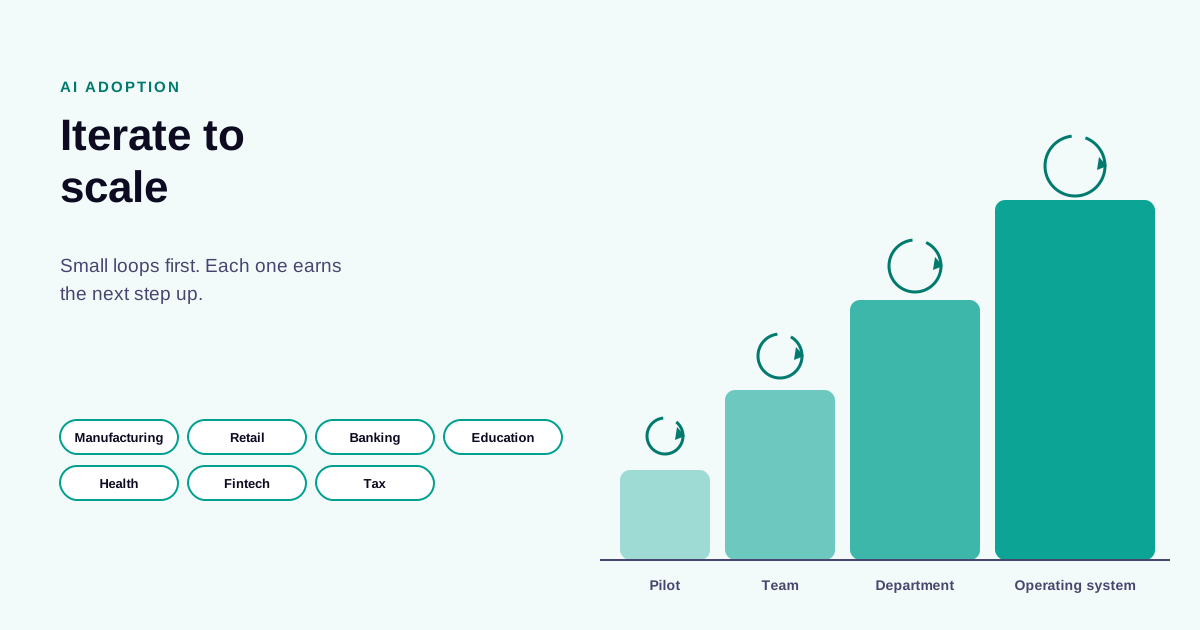
For teams in manufacturing, supermarkets, banking, education, healthtech, fintech and tax returns, AI is moving from experiment to operating system. The question is no longer whether to use models, but how to own the loop that produces reliable outputs at scale without surrendering control to a vendor console. A personal AI factory is the answer developers are building for themselves: a small, reproducible pipeline of instructions, agents and data that turns a prompt into a product, then repeats it.
What is a Personal AI Factory?
A personal AI factory is a developer-owned system for producing AI work consistently, distinct from ad-hoc notebooks or fully managed SaaS pipelines. Unlike a one-off experiment that relies on manual prompt tweaking in a chat UI, a factory encodes the workflow as versioned artifacts and agents that can be reproduced via API. The code it generates is disposable; the instructions and agents are the real asset [1]. The factory mindset treats output quality as a function of input design, not post-hoc patching.
When something goes wrong, I don’t hand-patch the generated code. I don’t argue with claude. Instead, I adjust the plan, the prompts, or the agent mix so the next run is correct by construction [1]. Fixing inputs, not outputs, is a guiding principle for building a personal AI factory [1].
In regulated sectors this matters. A tax return calculation, a clinical note summarizer, or a supermarket demand forecast cannot be “mostly right.” The factory encodes the constraints once and reuses them.
Building a Personal AI Factory with Distr and NVIDIA DGX Spark
Building starts with two choices: orchestration and compute.
Distr is an open source deployment control plane for AI workloads. Distr provides a comprehensive REST API that allows you to manage deployments, artifacts, controllers, licenses and more programmatically [2]. Distr can be self-hosted with a license key [2]. Self-hostable: Apache-2.0. One Go binary plus Postgres 18+, object storage, and Loki. Paid plans run self-hosted too [2].
Self-hosting is central for manufacturing and banking teams with data residency requirements. The REST API makes the factory programmable, which is the difference between a notebook and a pipeline.
For local compute, the NVIDIA DGX Spark is a desktop workstation for AI development. NVIDIA DGX Spark is designed for AI developers, researchers, data scientists, and students who need powerful, always-on AI compute on the desktop—without relying on cloud or data center access for every workload [3]. The Spark is firmly targeted at “AI researchers”. It’s designed for both training and running models [4].
Hardware specifics that shape factory design:
- Short version: this is an ARM64 device with 128GB of memory that’s available to both the GPU and the 20 CPU cores at the same time, strapped onto a 4TB NVMe SSD [4].
- With 20 Arm cores connected using C2C to a Blackwell generation GPU, 128GB of LPDDR5X memory, and 200GbE NVIDIA ConnectX-7 networking, the NVIDIA DGX Spark is exciting [5].
- The package is flanked by 128GB of LPDDR5X shared memory (rated at 273GB/s.) [5]
- What is inside is going to be a game-changer for those serious about local and portable AI development. Instead of a large, power-hungry rack server, this is a 170W device [5].
The platform is supported by NVIDIA now have extensive guides for getting things working on the Spark and they are a huge breath of fresh air—exactly the information I needed when I started exploring this hardware [4]. A lot of my initial challenges got easier when I found their official Docker container [4].
A minimal bootstrap with Distr can look like:
# create a deployment via Distr REST API
curl -X POST https://distr.local/api/v1/deployments \
  -H "Authorization: Bearer $DISTR_TOKEN" \
  -H "Content-Type: application/json" \
  -d '{
  "name": "factory-tax-agent",
  "artifact": "agents/tax-v1",
  "controller": "dgx-spark-01",
  "license": "selfhost"
  }'
The deployment is tracked, versioned and reproducible. The DGX Spark ships with DGX OS and additional NVIDIA tools. DGX OS is a Linux distribution based on Ubuntu and matches the Linux distribution running on other DGX platforms. DGX Spark comes pre-installed and/or supports a large catalog of tools, frameworks, models, and software for development use from NVIDIA NGC [3].
Getting started resources: Distr repo for API docs and self-host install, NVIDIA DGX Spark docs for hardware setup and enterprise manageability, and the official Docker container for runtime.
Managing and Optimizing Inputs
Input management is the factory floor. Distr’s API surface lets you treat prompts, plans, agent configurations and datasets as artifacts.
For healthtech and fintech, inputs include PII redaction rules, audit logs and model cards. For manufacturing, inputs include CAD schema and tolerance tables. For supermarkets, inputs include POS schema and promotional calendars.
Input design means concrete practices:
- Data curation: version datasets with schema checks and lineage, not just files.
- Prompt engineering: store system prompts, few-shot examples, and output schemas as artifacts in Distr.
- Agent mix: define roles, handoffs, and acceptance criteria as code.
Versioning inputs beats versioning outputs. When a model drifts on edge cases, the fix is in the prompt, the example set, or the agent mix, not in editing generated code.
Iterating on Inputs to Scale the Factory
You don’t get there in one big step. Here’s the secret sauce: iterate the inputs [1]. Iterating on inputs is key to scaling the factory, as it allows for rapid experimentation and improvement [1].
A practical loop:
- Define the task and acceptance criteria.
- Create a first agent with a minimal prompt and 3-5 examples.
- Run on a representative batch on DGX Spark.
- Log failures, adjust the plan, prompts, or agent mix.
- Re-deploy via Distr API and compare.
The factory's real asset is the instructions and agents, not the generated code itself [1]. That loop is the factory: the code itself is disposable; the instructions and agents are the real asset [1].
Clustering scales the loop. Up to 4 DGX Spark systems can be connected using NVIDIA ConnectX-7 networking. You can cluster two or three systems with a single QSFP cable; clustering 4 systems requires an external network switch [3]. The dual port NVIDIA ConnectX-7 NIC that we were told supports 200GbE clustering with a second unit [5].
Hardware options beyond a single Spark include self-hosted Distr controllers on existing servers, other ARM/x86 workstations, and scale-out with multiple Sparks. Two interconnected DGX Sparks can handle models with up to 405 billion parameters in FP4 [6].
DGX Spark networking options:
| Feature | Detail | Source |
|---|---|---|
| Shared memory | 128GB LPDDR5X available to GPU and 20 CPU cores | [4] |
| Ethernet | 10 GbE RJ-45 Ethernet port | [6] |
| Interconnect | two QSFP ports driven by NVIDIA ConnectX-7 NIC capable of up to 200 Gbps | [6] |
| Power | 170W device | [5] |
This matters for education and healthtech labs that need to scale from one desktop to a small cluster without re-architecting.
Benefits and Challenges of a Personal AI Factory
Benefits
- Control and compliance: self-hosted Distr means data stays on premise. Distr can be self-hosted with a license key [2].
- Speed: local DGX Spark removes cloud queue latency for iterative work. It is designed for both training and running models [4].
- Reproducibility: API-driven deployments make the factory auditable. Distr provides a comprehensive REST API that allows you to manage deployments, artifacts, controllers, licenses and more programmatically [2].
Challenges
- Input design requires disciplined prompt engineering and data curation. Fixing inputs, not outputs, is a guiding principle for building a personal AI factory [1].
- Hardware constraints: a single Spark is a 170W device [5] with 128GB shared memory [5]. Large-scale training still requires scale-out.
- Operational overhead: self-hosting Distr needs Postgres 18+, object storage, and Loki. Paid plans run self-hosted too [2]. You own uptime, backups, and license management.
For manufacturing, banking, supermarkets, education, healthtech, fintech and tax returns, the personal AI factory does not replace enterprise platforms. It creates a safe, fast sandbox where developers can prove an agent, lock down inputs, and then promote it.
Iterate the inputs, keep the instructions as assets, and let the generated code remain disposable. That is how a personal factory scales.
References
- Building a Personal AI Factory (July 2025 snapshot) — john-rush.com
- distr-sh/distr — github.com (17 November 2026)
- NVIDIA DGX Spark: AI Supercomputer on Your Desk — nvidia.com (24 August 2025)
- NVIDIA DGX Spark: great hardware, early days for the ecosystem — simonwillison.net (15 October 2025)
- The NVIDIA DGX Spark is a Tiny 128GB AI Mini PC Made for Scale-Out Clustering — servethehome.com (1 April 2025)
- NVIDIA DGX Spark In-Depth Review: A New Standard for Local AI Inference - LMSYS Org — lmsys.org (14 October 2025)